Dryer Vent Cleaning in Park Ridge, IL
Park Ridge carries the second-oldest housing stock of the suburbs we serve: 16.2% of its housing units were built before 1940, behind only Evanston's 40.3%, according to the Chicago Metropolitan Agency for Planning's Community Data Snapshots for Park Ridge and Evanston, drawn from Census Bureau American Community Survey estimates. Another 49.9% went up between 1940 and 1969, the same postwar wave that filled in Skokie and Niles. A house built before the household clothes dryer was common equipment never had a vent in its original plan — the duct was cut in later, by whoever did the work when the laundry finally moved indoors, and it follows whatever path they found rather than one a modern code would approve.
That older housing sits under a very different ownership pattern than Evanston's. 84.8% of Park Ridge's occupied homes are owner-occupied, and 75.2% of the housing stock is single-family, detached or attached — both from the same CMAP snapshot. Only 10.2% of units sit in buildings of 20 or more, a fraction of Evanston's share, where renters make up nearly half of households and barely a third of housing is single-family detached. Where our Evanston page is written for landlords tracking a rental registration deadline, this one is written for the homeowner standing in their own basement, wondering why a house their family has owned for decades still runs on a duct nobody currently living there has ever actually seen.
Old houses, untraced ducts
A city that has lived in its own housing this long keeps track of it. Park Ridge's Historic Preservation Commission runs a 100-Year-Old Homes recognition program, issuing a certificate to any home that reaches the century mark — proof that a real share of the city's housing is old enough to have been built, remodeled, and remodeled again before anyone currently living there owned it. In a house like that, a laundry room added decades after the original build or a duct rerouted during a later kitchen or basement remodel is the norm, and the paperwork for either almost never survives. Our first job on a call like this is not cleaning — it's tracing the run, foot by foot, because nobody currently living there can say where it goes.
Illinois winters add a second kind of wear to those same old houses. The Great Lakes region logs an average of 42 freeze-thaw cycles each winter, with the yearly count running as low as 23 or as high as 60, according to the University of Michigan's Great Lakes Integrated Sciences and Assessments program. That kind of repeated freezing and thawing is exactly what works loose the mortar joints in old masonry — the brick and stone construction common to Park Ridge's pre-1940 housing stock and its landmark buildings alike. That brick is a local tradition: the city was originally called Pennyville, after brickyard owner George Penny, and later went by Brickton before it became Park Ridge. A duct that runs through or behind masonry like that is one more reason we trace the whole path before cleaning it, rather than assuming it matches whatever a newer house nearby has.
What Park Ridge's own code requires
Park Ridge has adopted the 2021 ICC family of International Codes — including the International Residential Code and International Mechanical Code — with the update applying to permits submitted from 2024 onward, administered by the city's Department of Community Preservation & Development at 505 Butler Place. Routine cleaning is maintenance and needs no permit. A new or rerouted duct — the kind that shows up when an old house finally gets its laundry room moved or added — is mechanical work, and it does. The core rule carries over from house to house regardless of age: dryer exhaust has to terminate outdoors, never into an attic, soffit, or crawl space. As of 2026 that is the standing requirement; confirm current details with the City of Park Ridge before scheduling anything beyond a cleaning.
Uptown's landmarks, and what they say about the houses around them
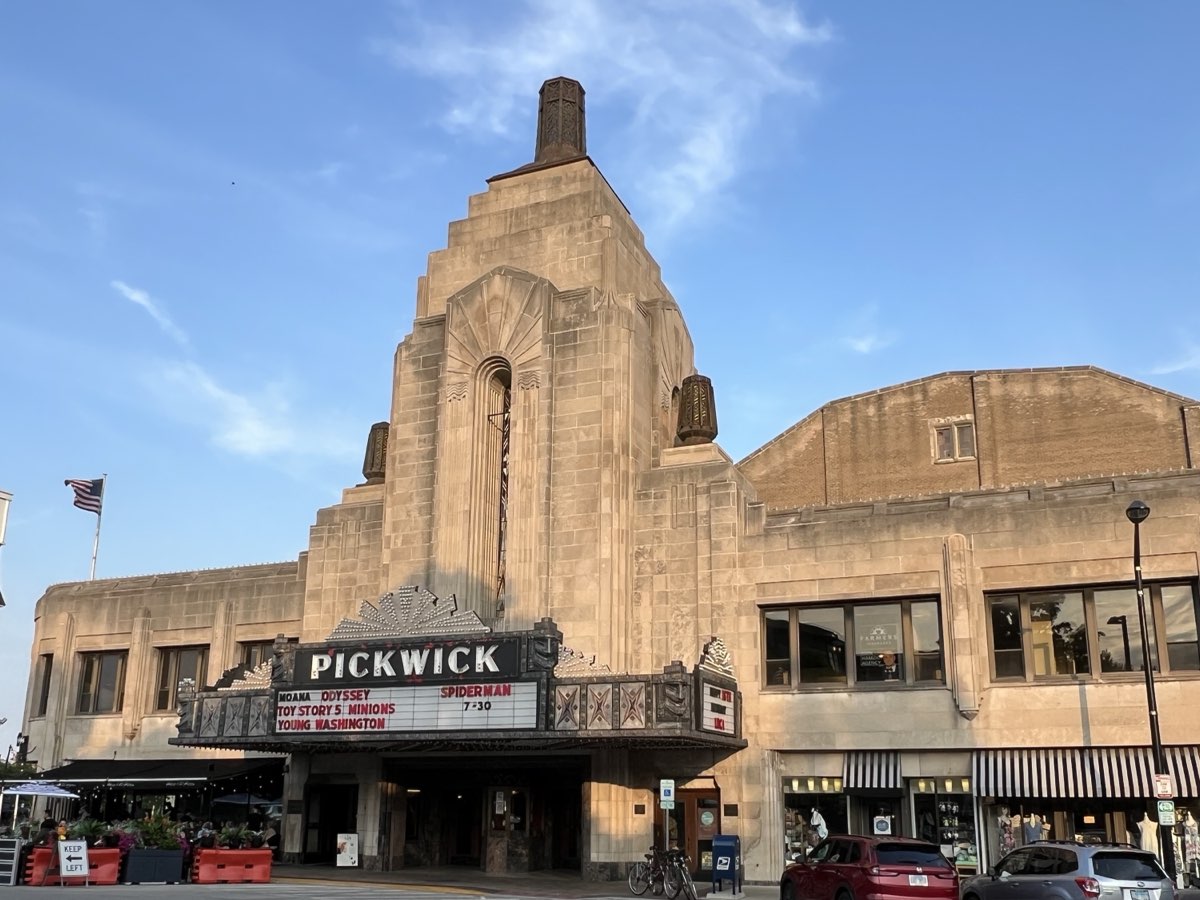
Park Ridge's Uptown business district, anchored by the Pickwick Theatre's 100-foot Art Deco tower, is the clearest physical evidence of how old parts of this city actually are. The Pickwick opened in 1928, designed by architects R. Harold Zook and William McCaughey with sculptor Alfonso Iannelli, and has been listed on the National Register of Historic Places since 1975. Iannelli's own studio, a few doors away at 255-257 North Northwest Highway, was designated a Park Ridge landmark in 2012. Farther out on Grand Boulevard stands the Malone House at 201 Grand Boulevard, built for the city's second mayor, William H. Malone — older still than the Pickwick. None of these buildings, or the houses that filled in around them over the following decades, were wired for a dryer when they went up. Every vent serving them today is an addition.
The other reason vents clog here
Park Ridge's Forestry Division maintains more than 20,000 parkway and city-owned trees, and the canopy has a history that matters to an exterior vent hood: elms once made up more than half of it — over 10,000 of them in 1969 — and Dutch elm disease wiped out nearly all of them in the decades since, leaving only about 460 remaining today. The ash trees planted to replace them are now under pressure from the emerald ash borer. Falling limbs and heavier leaf litter are an ongoing reality for local roofs, gutters, and low sidewall vent hoods alike. If yours is blocked by nesting material rather than storm debris, that's a different job.
What a visit includes
Here is what happens on a Park Ridge home. Most single-family visits run 45 to 90 minutes — but in a house where nobody has ever traced the full duct, the first few minutes matter more than they do in most houses.
1. Inspection and quote. In a pre-1940 or heavily remodeled Park Ridge house, this step often takes longer than the cleaning itself: we're mapping the run for the first time, not confirming one from a plan on file, and the price is not named until that map is done.
2. The transition hose. The flexible connector behind the dryer, which holds the densest lint in the whole system, gets disconnected, cleared, and reseated.
3. The full duct run. A rotary brush works every foot and every elbow of the concealed duct while a high-volume vacuum pulls the loosened lint out behind it — more elbows than a modern route, in a retrofit run threaded around joists and plumbing that were never planned to share a wall with it.
4. The exterior termination. Whether it lands near grade on a Cape Cod or two stories up on a larger colonial, the hood and flap get cleared and checked for free swing — see bird nest removal if a blocked hood, not lint, turns out to be what's actually slowing your dryer.
5. Airflow verified before and after. A reading at the start sets the baseline; the same test after cleaning proves the difference, with photos of what came out of the duct.
If the inspection turns up a crushed section, a run that was never sized right, or duct that needs replacing rather than cleaning, that is vent repair work, priced and explained before it's added to anything. If what you actually have is a whole-house ductwork question rather than a single dryer line, see our air duct cleaning page for how that service differs; our main dryer vent cleaning page covers the general mechanics of a standard visit, and our cost guide breaks down what drives the price beyond termination point.
What it costs in Park Ridge
Most single-family Park Ridge jobs run $80 to $250 depending on where the vent terminates. That range comes from Angi's Chicago-specific termination-type breakdown below; Angi's overall Chicago figures put the typical range at $129 to $222 with a $173 average, and the full survey spread at $95 to $350 depending on the house. Park Ridge's older, untraced-duct houses tend toward the upper half of the termination-based range since they take longer to trace than most. What moves you within it:
Whether the run has ever been mapped. A duct with a permit or remodel record on file is faster for us to clear than one that has to be traced blind, which is common in Park Ridge's older houses and pushes a quote toward the upper end.
Duct length and elbow count. A retrofit run bent around a finished basement or a relocated laundry room takes longer to brush than a short, direct one.
Sidewall vs. roof termination. Angi's data breaks it out by location: basement and first-floor terminations run $80 to $185, second-floor runs $110 to $185, and roof terminations run $150 to $250. A low termination near grade is the fastest to reach; a roof or high-sidewall termination on a taller colonial means ladder work and lands at the top of that scale.
Years since the last cleaning. A vent that has never been cleaned, or hasn't been touched since a decades-old remodel, holds more lint and takes longer to clear.
What to look for
North Shore Dryer Vent handles your Park Ridge job directly — one team, a firm quote, no bidding war for your number. More on how we work.
Here is what to look for before you book: proof of insurance, a written quote agreed before work starts, and photos of the completed job. Ask for a before-and-after airflow reading too. On a hundred-year-old Park Ridge house, where there is no plan on file to price against, that written scope is the only honest way to quote the job.
The number quoted up front should be the number you pay, with nothing added to it after the fact without your approval.
Nearby areas
We also cover Niles, Morton Grove, Glenview, and Skokie. Questions before you book? See our advice library or contact us directly.
Sources
- Chicago Metropolitan Agency for Planning — Community Data Snapshot: Park Ridge (housing age, tenure, rooms, and units-in-structure, 2020–2024 American Community Survey estimates)
- Chicago Metropolitan Agency for Planning — Community Data Snapshot: Evanston (housing age, tenure, and units-in-structure, 2020–2024 American Community Survey estimates, cited for comparison)
- City of Park Ridge — Permits & Inspections, Department of Community Preservation & Development
- City of Park Ridge — 2021 ICC Building Code Update
- City of Park Ridge — Historic Preservation Commission & 100-Year-Old Homes recognition
- National Register of Historic Places — Pickwick Theatre
- Park Ridge Historical Society — Park Ridge Landmarks
- City of Park Ridge — Urban Forest Management (parkway tree count, Dutch elm disease history)
- Great Lakes Integrated Sciences and Assessments, University of Michigan — Freeze-Thaw Cycles (regional freeze-thaw cycle counts, 1951–2020 NOAA GHCN-D analysis)
- Angi — How Much Does Dryer Vent Cleaning Cost in Chicago, IL? (Chicago-specific dryer vent cleaning cost data, survey-based, updated July 8, 2026)
A hundred-year-old house deserves a duct someone has actually traced.
Call (224) 327-6827Park Ridge questions
How much does dryer vent cleaning cost in Park Ridge, IL?
Most single-family jobs land between $80 and $250 depending on where the vent terminates, quoted firm once we've traced the actual duct — never guessed over the phone. That is close to what Angi's Chicago-specific data shows for this work overall: a typical range of $129 to $222 with a $173 average, and a full spread of $95 low to $350 high depending on the house. Park Ridge's older houses and heavily remodeled retrofits tend to land toward the upper half of that range, since an untraced run takes longer to map and clear than a short, code-planned one — that tracing time matters here regardless of where the vent itself terminates. Condo and multi-unit buildings are priced per building.
My house is registered in Park Ridge's 100-Year-Old Homes program — does that change the cleaning?
It changes the inspection more than the cleaning itself. A home old enough for the city's own Historic Preservation Commission to certify predates the household dryer entirely, so its duct is a retrofit with no builder's plan to check against. We spend more time tracing the run before quoting — through a basement remodel, an added laundry room, or a chase nobody currently in the house installed — and that mapping step is standard on a Park Ridge house this old, not an upcharge.
Does Park Ridge require a permit for dryer vent cleaning or repair?
Cleaning is maintenance and needs no permit. Park Ridge has adopted the 2021 International Residential and Mechanical Codes, administered by the city's Department of Community Preservation & Development, and a new or rerouted duct — common when an old house gets a laundry room relocated — counts as mechanical work that does require one. Either way, the underlying rule is the same: exhaust has to terminate outdoors, never into an attic or crawl space. Confirm current requirements with the city before scheduling anything beyond a cleaning.
How long does dryer vent cleaning take in Park Ridge?
Most single-family cleanings run 45 to 90 minutes once we're on site. In a Park Ridge house where the duct has never been traced — common in the city's pre-1940 and immediate postwar housing — the inspection at the start of the visit takes longer than in a newer suburb, because we're mapping the run for the first time rather than confirming one against a permit file. A roof termination or a long second-floor run adds time on top of that.
Can I clean my own dryer vent instead of hiring a pro?
If your laundry sits on the ground floor with a short, straight shot to a nearby exterior wall, a homeowner with a real vent-cleaning brush kit and a shop vac can often do that job. Park Ridge's older housing makes that description less common than it sounds — retrofit runs bent through remodeled basements, second-floor laundry, and roof terminations are all jobs a rented brush kit cannot reach end to end. If you cannot see the whole run from either end, that is the signal to call us instead of guessing.
Does a bigger Park Ridge home cost more to service than a smaller house nearby?
Sometimes, honestly. Park Ridge's median home has 6.6 rooms, well above the 5.1-room median across Cook County, and more rooms usually means more distance between the laundry and the nearest exterior wall — second-floor laundry, a longer horizontal run, occasionally a roof termination. Most cleanings still land inside that $80 to $250 range; what changes is where in that range your quote falls, and we explain why before starting, not after.
Request a free Park Ridge quote
Submit this and we'll reach out directly to set up your free quote — no bidding war, no five contractors competing for your call. There's no cost and no commitment to book.